When selecting an overhead crane, many companies focus primarily on lifting capacity and span, while overlooking one critical factor — factory building height. In reality, the clear height of a workshop directly determines lifting height, girder structure type, hoist configuration, and overall operational safety. Different building heights require completely different structural design strategies.
This article systematically analyzes how factory height influences overhead crane structure selection from the perspectives of clear height, girder configuration, low-headroom design, rail position, and safety clearance.
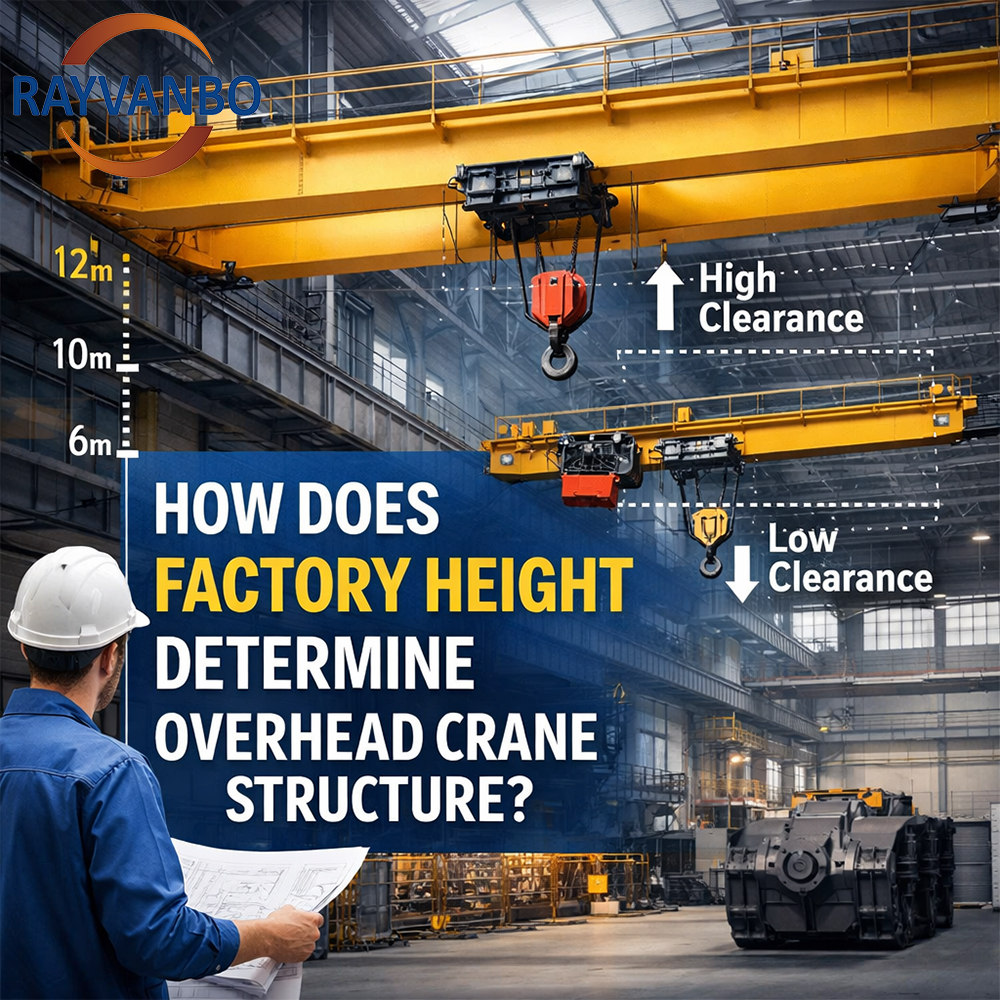
Factory height directly influences:
Ignoring these relationships may result in limited lifting performance or costly modifications.
When factory height is limited, the core objective of overhead crane structure must be "saving vertical space."
Single-Girder Structure Offers Advantages
Single-girder overhead cranes have a lower overall structural height, with the electric hoist suspended below the main beam, occupying relatively less space. For small to medium tonnage workshops, the single-girder structure can achieve reasonable lifting space within limited height, making it a cost-effective choice.
Low Headroom Design Improves Space Utilization
When factory height is limited, low headroom bridge cranes become an ideal choice. Low headroom designs typically employ a European-style main beam structure, with the electric hoist mounted on the side of the main beam or embedded in it, allowing the lifting mechanism to be closer to the top of the main beam, thereby increasing the effective lifting height.
Compared to traditional structures, low headroom bridge cranes can increase lifting space, which is especially crucial for workshops with height restrictions. Particularly in the case of renovating old factories or steel structure factories where the height cannot be increased, low headroom design can achieve maximum lifting stroke without altering the building structure.
This structural form not only improves space utilization but also helps companies save on factory expansion costs.
Employing Low Headroom Electric Hoists
Low headroom design is a key solution to insufficient height. By mounting the electric hoist on the side of the main beam or embedding it inside the main beam, the effective lifting stroke can be significantly increased. Compared to traditional arrangements, low headroom structures can increase lifting space by several hundred millimeters, which is especially important in factories with height restrictions.
When the factory's net height exceeds 10 meters or even 12 meters, the structural design of bridge cranes becomes more flexible.
Double-Girder Structure Offers Better Space Utilization
Double-girde bridge cranes allow electric hoists or trolleys to operate between two main beams, and the hook can rise to a higher position below the top of the main beams, thus achieving greater lifting height. This structure is particularly suitable for lifting large-tonnage equipment and in heavy manufacturing industries.
Configurable Auxiliary Lifting Systems
High factory environments provide space for installing double-trolley structures, auxiliary hook systems, or intelligent control systems. By making reasonable use of vertical space, lifting efficiency can be improved and production cycles optimized.
Main Beam Structure Can Be Strengthened
With sufficient height, a reinforced box girder structure can be used to improve load-bearing capacity and operational stability, making it suitable for high-frequency, heavy-load conditions.
The running rails of bridge cranes are typically installed on factory building columns or crane beams. The installation height of the rails directly affects the dimensions of the main beam structure and the overall height layout.
If the rail beam is installed low, the crane structure must be compressed in height; otherwise, the lifting stroke will be affected. In this case, a thin main beam structure or an optimized electric hoist installation method can be used. If the rail beam is installed high, a standard or reinforced main beam structure can be used to meet the requirements of large tonnage and high-intensity operations.
During the design phase, the load-bearing capacity of the rail beam, the strength of the main beam structure, and the building safety distance should be comprehensively considered to ensure a reasonable match between the bridge crane structure and the factory building height.
Regardless of the factory building height, the structural design of bridge cranes must maintain necessary safety distances, including:
A reasonable structural design should meet national and industry safety standards while ensuring the maximum lifting height. Excessively compressing the structural height may result in a greater lifting stroke, but it will affect the safe operation of the equipment and subsequent maintenance. Therefore, the structural design of bridge cranes must find a balance between "maximum lifting height" and "safe operating space".
6.Differences between New Factory Buildings and Renovated Old Factory Buildings
New Factory Buildings:
During the planning stage, the crane beam height should be designed in advance based on the future lifting capacity and equipment specifications. Appropriately raising the track installation position can reserve space for future equipment upgrades.
Renovated Old Factory Buildings:
When the height cannot be changed, priority should be given to designs using low-headroom bridge cranes, European-style lightweight main beams, and compact electric hoists to maximize the use of existing space.
7.Conclusion: Height Determines Structural Logic
Factory building height is not merely an architectural parameter, but the logical starting point for overhead crane structural design.
Scientifically matching factory building height with overhead crane structural form can avoid repeated modifications and additional investment, while improving production efficiency and safety levels.
For companies planning to build new factories or upgrade material handling systems, systematically matching factory building height with bridge crane structural solutions at the initial project stage is a crucial step in achieving an efficient, safe, and sustainable production layout.
 Hot News
2026-09-21
2026-09-02
2026-08-19
2026-07-15
2026-07-09
2026-07-01
 EN
EN