A overhead crane, a gantry crane and a jib crane can all lift a load of the same weight. What changes is how the crane is supported and where it can take that load. An overhead bridge crane can serve several machines in one bay without putting legs in the aisle. A rail-mounted gantry can cover a yard without an elevated runway. A jib crane gives one machine or assembly station its own lifting area without occupying the main bridge crane.
Once you know which of those jobs you need to do, the differences between the designs become easier to judge. The following guide compares the RAYVANBO crane types and explains where the choice of structure, hoist and controls makes a practical difference.
| Crane type | How it is supported | Where it fits |
| Single-girder overhead crane | One bridge girder on elevated runways; the hoist typically runs beneath it | General fabrication, assembly and material transfer across a bay |
Double-girder overhead crane |
Two bridge girders with a trolley typically running on top |
Heavier lifts, wider bays or projects where trolley layout affects hook height |
Rail-mounted gantry crane |
Bridge carried on legs that travel along ground rails |
Steel yards, precast plants and indoor routes without a practical overhead runway |
Mobile gantry frame |
Portable beam and legs on wheels |
Maintenance, tool changes and occasional lifts at different work areas |
Column-mounted jib crane |
Freestanding mast on a suitable foundation |
A dedicated workstation away from usable walls or columns |
Wall-mounted jib crane |
Brackets attached to a verified wall or structural column |
A fixed workstation where floor space is limited |
Mobile jib crane |
Stable base designed for relocation |
Local lifting where the workstation itself moves |
Overhead Bridge Cranes: What Changes from Single to Double Girder?
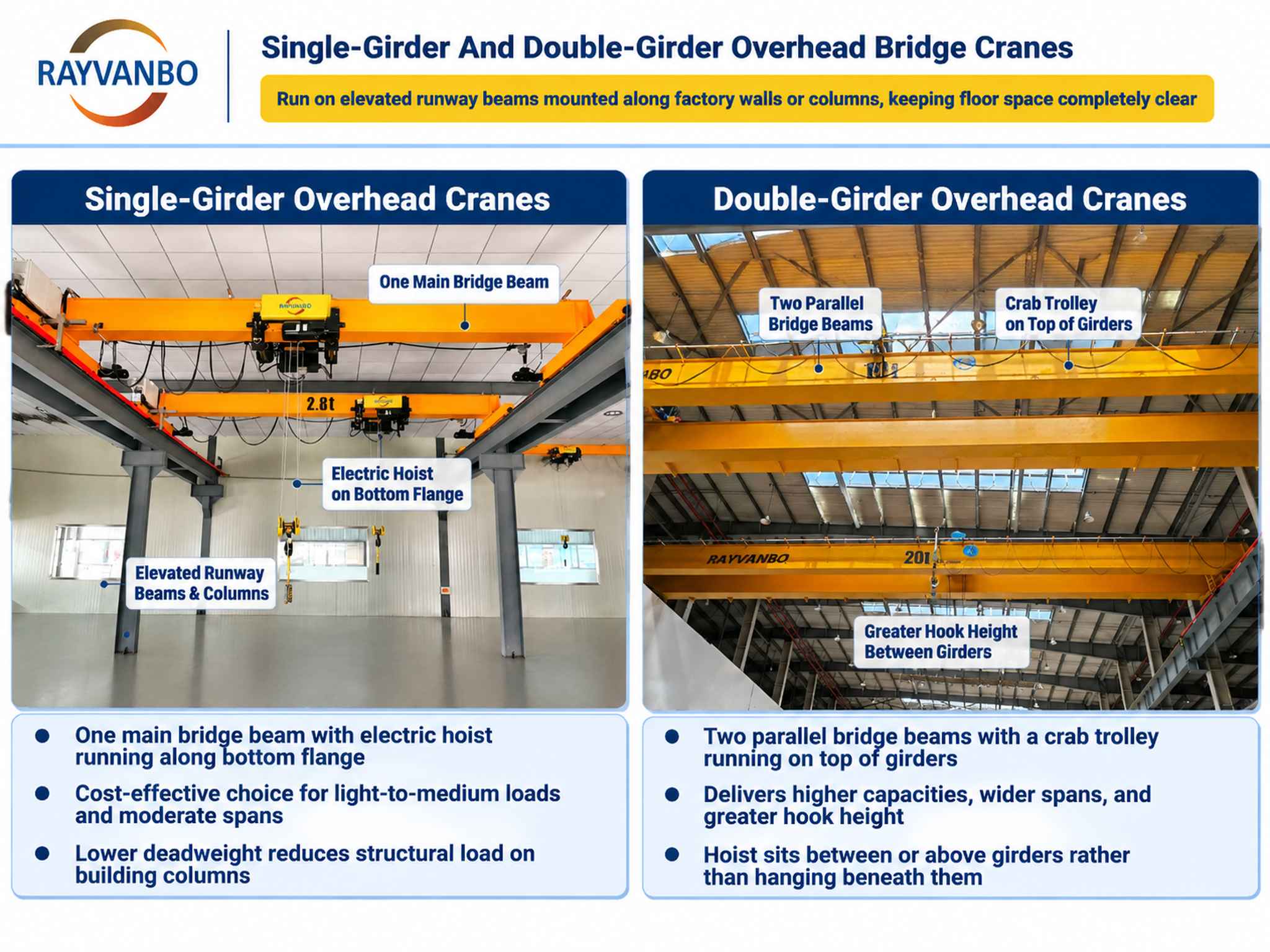
On a typical single-girder crane, the hoist trolley runs on the lower flange of the bridge girder. The bridge itself travels along elevated runways. That arrangement gives the factory coverage in two directions while leaving the floor available for machines, transport and storage. If the single-girder design reaches the required pick-up and set-down points and meets the capacity and duty requirements, a second girder is not needed just because the crane will be used in production.
A typical double-girder crane carries its trolley on rails above the two bridge girders. Depending on the design, the hook can rise between the girders, which may recover usable lifting height. This arrangement is also worth comparing when a heavier load or wider span changes the structure required. On RAYVANBO single- and double-girder layouts, look at the highest hook position and how close the hook can approach the sides and ends. A design can improve one dimension without improving the other. For a retrofit, compare the proposed wheel loads as well; an existing runway is not automatically suitable just because its span matches.
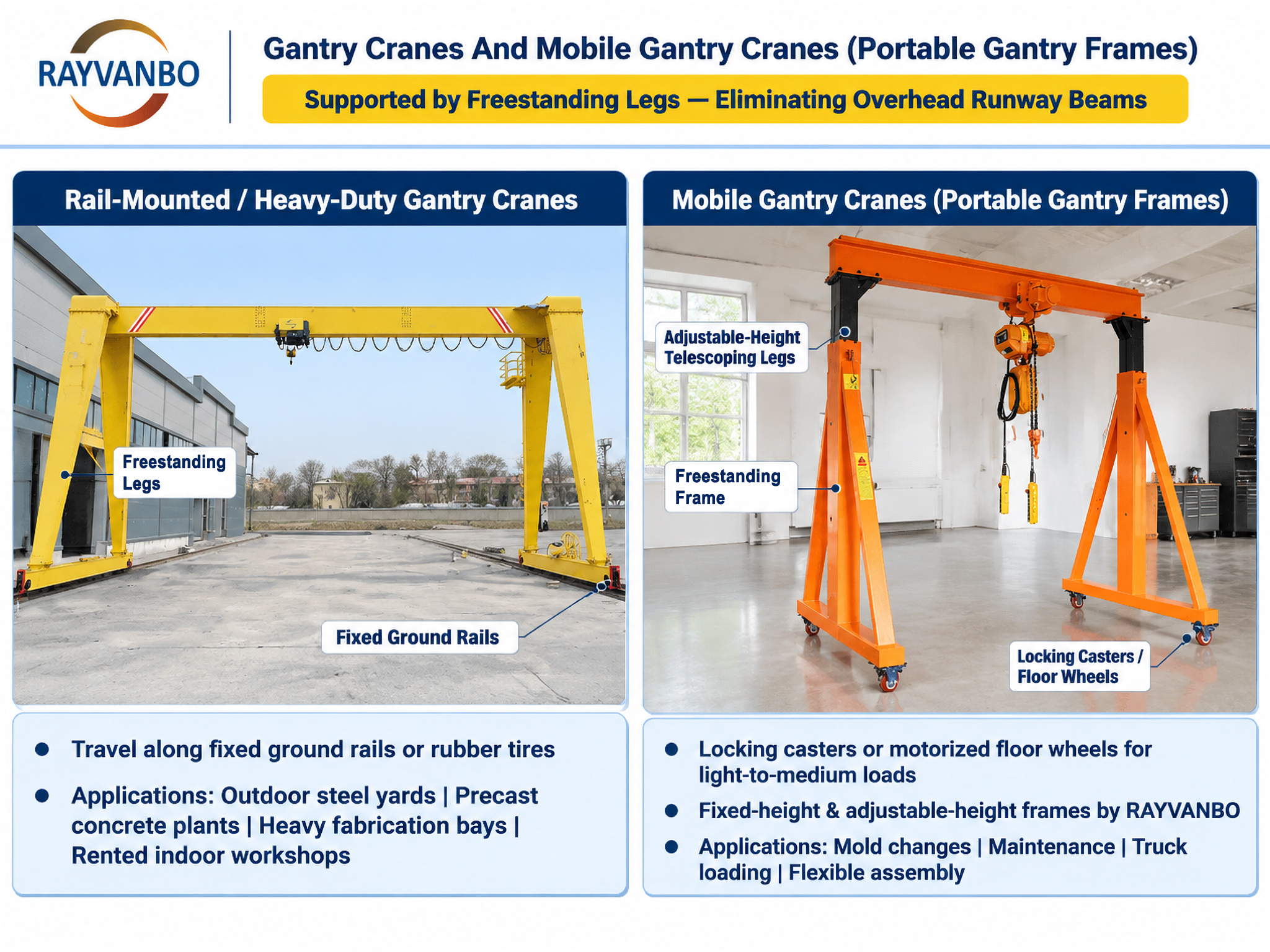
A rail-mounted gantry carries its bridge on legs, transferring the load to a ground runway rather than to elevated runway beams. It suits a regular route, such as moving steel between a stockyard and a loading area. Putting the runway at ground level can avoid work on the building structure, but it does not eliminate civil works. The rails and their supports must suit the crane, and the moving legs must clear trucks, stacked materials and access routes.
A mobile gantry frame is a portable lifting point, not a smaller version of a yard crane. It makes sense when a maintenance crew needs to lift a pump in one area and change tooling in another. A fixed-height frame may be enough when the work areas are similar; an adjustable-height design is worth comparing when beam height needs to vary between locations. On a RAYVANBO mobile frame, the clear width between the legs tells you whether it can straddle the equipment. The overall beam length does not. Also distinguish moving the empty frame between jobs from travelling with a suspended load. Loaded travel is only an option if the proposed model and its instructions expressly permit it.
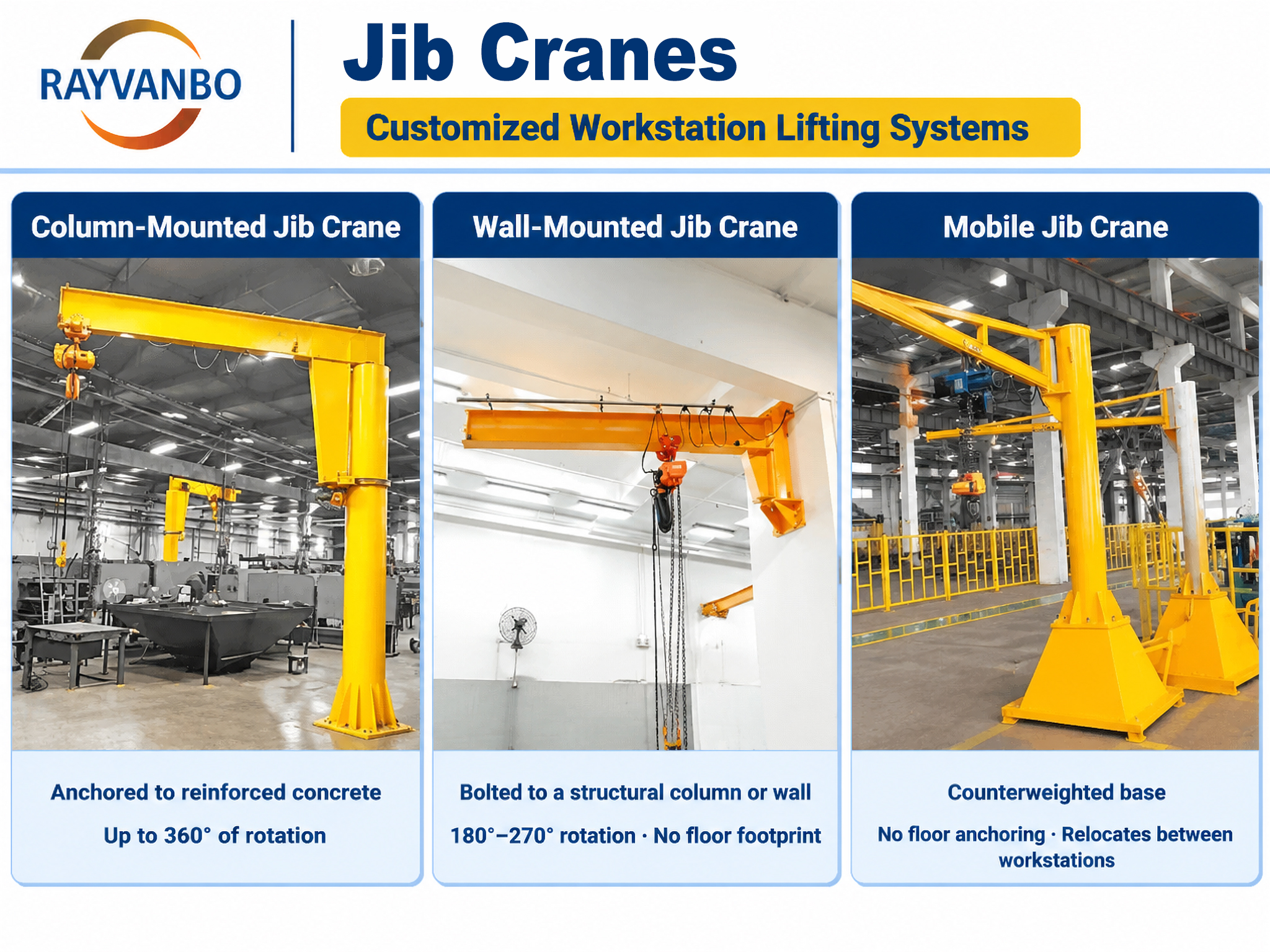
A jib crane covers the area swept by its boom. It is a natural fit for loading a CNC machine, handling fixtures at a welding station or moving parts between a bench and a nearby cart. A column-mounted jib can serve an open workstation, provided the foundation can take the loads. A wall-mounted jib leaves the floor free of a separate mast, but transfers those loads into the wall or column. The supporting structure must be checked for that purpose.
A mobile jib is worth considering where a station needs to move and permanent anchoring is impractical. The base takes up floor space, however, and its suitability depends on the equipment design and floor conditions. For any RAYVANBO jib configuration, judge the usable working radius and rotation, not just the arm length. A longer arm is of little use if a machine guard stops the boom short of the drop-off point.
A crane can fit under the roof and still leave too little room to lift a mould over a machine guard. Headroom is the space available for the crane and hoist; lifting height is how far the hook needs to move. On a low-clearance project, compare these dimensions on the same drawing. Show the lowest obstruction and the highest required hook position, with the load and lifting gear in place.
Where overhead space is tight, compare hoist arrangements before fixing the bridge layout. The useful figure is the highest hook position each arrangement can achieve in that building, not whether the hoist is described as compact.
A maintenance crane that lifts a motor during a shutdown and a production crane that loads a machine all day may have the same rated capacity. The production crane may handle lighter parts most of the time, yet its mechanisms start, stop and travel far more often. Maximum load and frequency of use tell you different things.
A description of a normal shift and a busy one is enough to start: how many lifts take place, what the typical loads weigh and how far the crane usually lifts and travels. Include any planned increase in shifts or throughput. If a quotation gives an ISO, FEM or CMAA classification, establish which system is being used and whether the rating applies to the complete crane or an individual mechanism. Don’t compare the class labels as if they mean the same thing.
Operating and parking conditions can be different. An outdoor gantry might work under a canopy and spend the night in the open. Inside a factory, one bay may be cool and dry while the next is exposed to heat, dust or corrosive conditions. Describe what the equipment will actually be exposed to. If there is a documented hazardous-area classification, the project team should use it to establish the equipment and documentation required.
For power, use the voltage, frequency and phase at the intended connection point. Naming the destination country does not tell the supplier what supply is available in that particular bay.
If a die has to settle onto locating pins, the operator needs a slow, controllable final descent. Faster bridge travel won’t make that part of the job easier. On a long transfer route, however, trolley and bridge travel may matter more. Compare dual-speed or variable-speed control for the motion that needs it, rather than specifying the same arrangement for every movement.
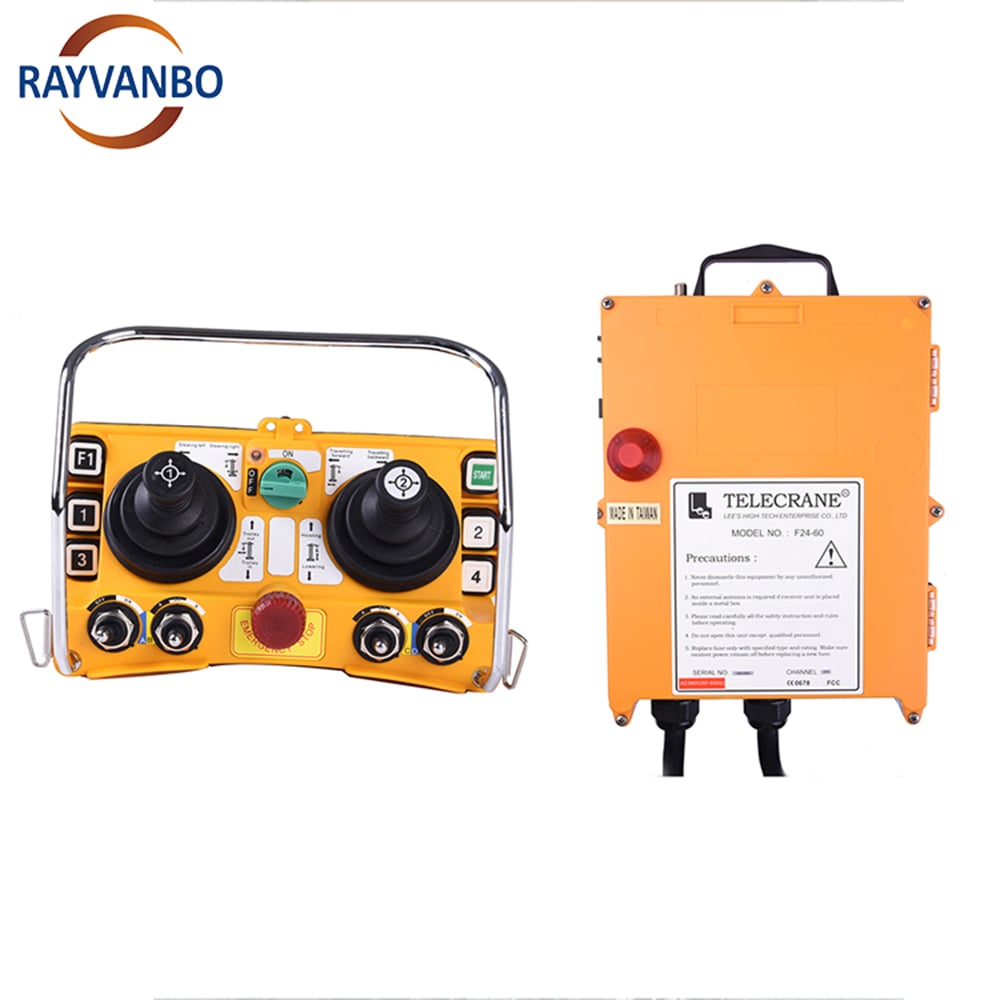
Choose between a pendant and a radio remote with the operator’s working position in mind. Can they see both the load and the landing point? Then review the protective functions for the proposed configuration, such as lifting and travel limits, overload protection or jib rotation stops, as applicable. Shared runways and adjacent operating machinery also need to be addressed in the layout and operating procedures.
When comparing crane quotations, look beyond initial equipment price. At RAYVANBO, we help global factories optimize Total Cost of Ownership (TCO) across the project lifecycle:
Whether you are outfitting a new plant or upgrading an existing workstation, the RAYVANBO team can configure a tailored lifting solution for your exact structural and operational requirements.
Contact RAYVANBO today for a customized crane proposal and quotation. Send us your basic parameters—or attach your workshop layout drawing:
Share your project requirements with RAYVANBO, and our team will provide a tailored technical configuration and factory quotation for your workshop.
 Hot News
2026-11-24
2026-10-29
2026-09-21
2026-09-02
2026-08-19
2026-07-15
 EN