1. Why Lifting Speed Matters More Than You Think?
In industrial overhead material handling, specifying the right electric hoist is about much more than rated capacity (tonnage) and lift height. One of the most critical—yet frequently overlooked—specifications is lifting speed control.
Plant managers, crane fabricators, and procurement engineers consistently face a pivotal decision: Should you invest in a standard single speed hoist, or upgrade to a dual/double speed hoist?
Choosing the wrong speed configuration inevitably leads to one of two costly outcomes:
- Overspending capital: Paying unnecessary premiums for micro-positioning capabilities on coarse bulk-handling applications.
- Damaging high-value goods & bottlenecking production: Causing load swings, workpiece collisions, or premature brake failure because standard speeds are too fast for delicate placement.
This engineering guide examines motor mechanisms, positioning tolerances, component wear cycles, and cost trade-offs to help you select the exact hoist configuration for your operational needs.
2. Working Principle & Motor Mechanisms
Understanding how each hoist controls speed is essential for evaluating long-term reliability and operator control.
Single Speed Hoists: Direct & Reliable Workhorses
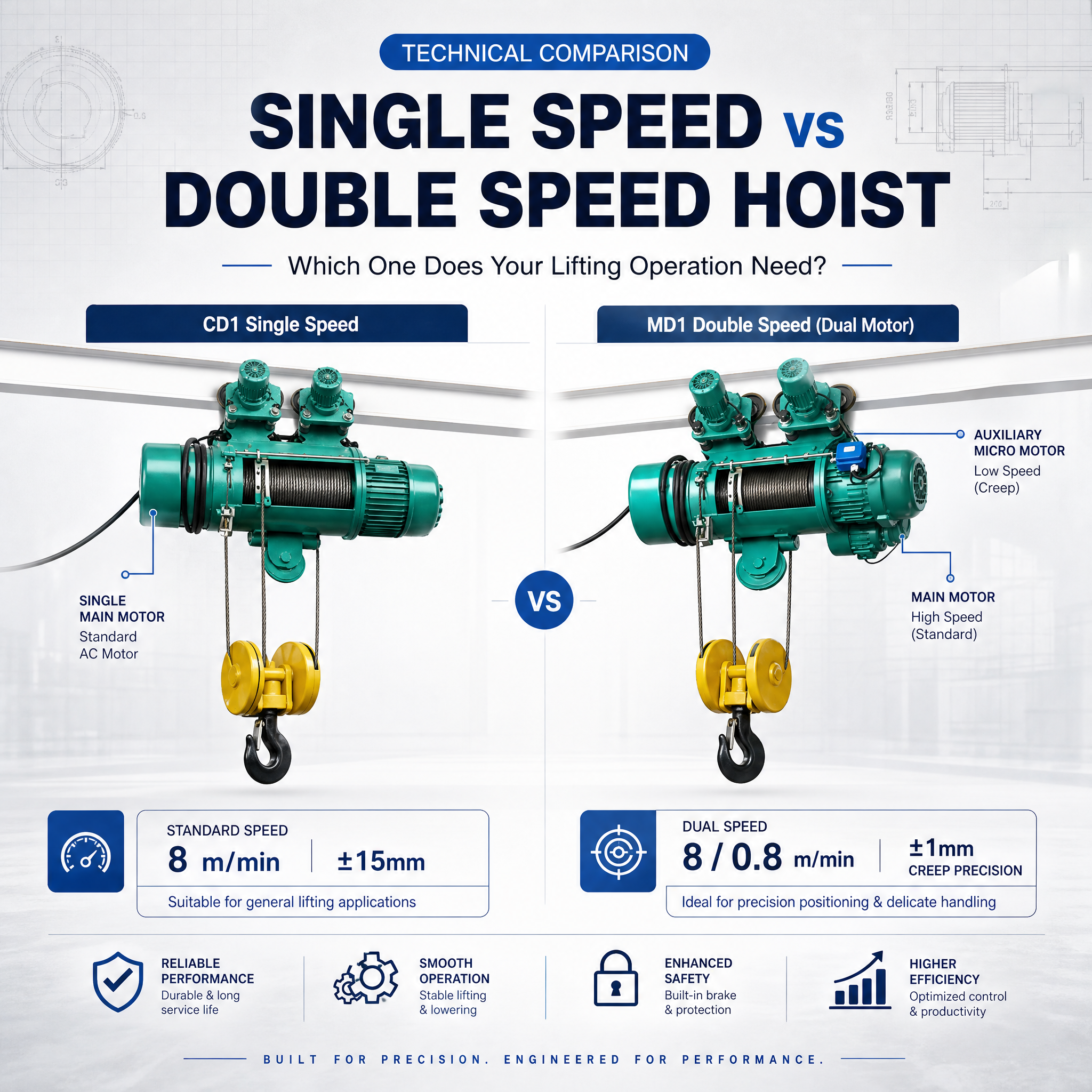
A single speed hoist is powered by a standard single-winding AC squirrel-cage induction motor. When the operator presses the "UP" or "DOWN" button on the pendant station or radio remote, the motor accelerates immediately to its rated full speed.
- Standard Speed Range: Typically 8 m/min on industrial wire rope hoists (such as standard CD1 models) or 4–6 m/min on electric chain hoists.
- Control Architecture: Direct-on-line (DOL) contactor control.
- Operator Reality: The hoist operates on an "all-or-nothing" basis. When an operator needs to make a small vertical adjustment (e.g., aligning a bolt hole), they must repeatedly tap the push button—a technique known as inching or jogging. This frequent arcing degrades electrical contactors and accelerates mechanical brake shoe wear.
Double Speed Hoists: The Power of Creep Speed
A double speed hoist incorporates a specialized mechanical or electrical drive arrangement that provides two distinct operating speeds: a rated fast speed for swift, productive travel across long lifts, and a slow creep speed (commonly 1/10th or 1/3rd of the fast speed, such as 8 m/min and 0.8 m/min) for micro-positioning.
There are two primary manufacturing configurations:
- Dual-Motor Planetary System (e.g., Industrial MD1 Wire Rope Hoists): The hoist features a main hoisting motor for high speed and an auxiliary micro-motor coupled to a compact planetary reduction gearbox. When creep speed is engaged, the auxiliary motor drives the main motor shaft through the planetary gear, delivering exceptionally smooth, low-rpm torque.
- Pole-Changing Motor System (e.g., Dual-Speed Electric Chain Hoists): Employs a single motor frame with dual stator windings (e.g., 4/12 poles or 2/8 poles). Switching between the windings alternates the motor's synchronous speed, providing a clean step-change in lifting velocity.
- Operator Reality: Dual-step detent push buttons. Pressing the button halfway engages slow creep speed for tensioning slings and landing loads gently. Depressing the button fully engages full rated speed for rapid cycle times.
3. Engineering Comparison: Single Speed vs. Double Speed
| Technical Specification |
Single Speed Hoist (e.g., CD1) |
Double Speed Hoist (e.g., MD1) |
Practical Impact on Operations |
| Speed Ratio |
1:1 (Fixed, e.g., 8 m/min or 5 m/min) |
10:1 (8/0.8 m/min) or 4:1 (8/2 m/min) |
Double speed delivers true slow creeping without jerky jogging. |
| Positioning Accuracy |
±15 mm to ±30 mm |
±1 mm to ±3 mm (Millimeter Precision) |
Crucial for mating tight-tolerance assemblies and machine tool beds. |
| Rigging & Load Shock |
High starting jerk; requires skilled sling feathering |
Near-zero shock loading on slings & loads |
Eliminates abrupt chain snapping and workpiece surface marring. |
| Brake & Contactor Lifespan |
Moderate to Low (eroded by frequent jogging) |
High (Extended life by 2.5x–3x) |
Slow speed cushions kinetic energy prior to mechanical brake engagement. |
| Capital Equipment Cost |
Baseline (Lowest initial CapEx) |
+15% to +35% over single speed |
Modest price difference that pays back quickly in zero workpiece scrap. |
| Pendant Ergonomics |
Single-step push buttons |
Two-step progressive detent buttons |
Tactile feedback gives operators intuitive, fatigue-free control. |
| Duty Classification |
Typically FEM 1Am / ISO M4 |
Typically FEM 2m / ISO M5 |
Better thermal dissipation and duty rating for intensive shifts. |
4. When Should You Choose a Single Speed Hoist?
A single speed hoist is the most cost-effective and dependable choice when throughput speed and capital budget take precedence over sub-millimeter precision.
Key Applications:
- Bulk Material Handling & Raw Stock Yards: Transferring steel beams, rebar bundles, structural tubing, timber, and scrap buckets where landing precision is non-critical.
- Outdoor Gantry Cranes & Truck Depots: Loading and unloading flatbed trucks, shipping containers, and outdoor yard racking where rigging clearances are generous.
- Low-Frequency Maintenance Bays: Auxiliary workshops, pump stations, or compressor rooms where the hoist is operated only 2 to 5 times per week for equipment overhaul.
- Tight-Budget Warehouse Installations: Facilities where initial capital expenditure is restricted and operators handle rugged, non-fragile payloads.
5. When Is a Double Speed Hoist Non-Negotiable?
In modern precision manufacturing, investing in a double speed hoist is not a luxury—it is an operational necessity to protect expensive machinery, tooling, and personnel.
Key Applications:
- Die & Injection Mold Handling: Lowering a 10-ton mold into a multi-million-dollar injection molding machine or stamping press requires absolute zero-impact touchdown. Single-speed jogging risks cracking expensive guide pins and damaging polished parting lines.
- CNC Machining Centers & Lathe Loading: Mounting heavy rough castings, turbine shafts, or fabricated engine blocks directly into chucks and fixtures requires sub-millimeter vertical and horizontal control.
- Glass, Ceramics & Brittle Materials: Lifting glass sheets, stone slabs, or pre-cast architectural concrete components requires tension-controlled take-off to prevent micro-fractures caused by abrupt shock loading.
- Foundries & Liquid Metal Transport: Pouring or transferring molten ladles demands smooth, vibration-free speed transitions to eliminate splashing risks.
- Aerospace, Defense & Heavy Machinery Assembly: Aligning multi-stage turbine housings, gearboxes, and large bearings where human technicians work in close proximity to the suspended load.
6. What About Variable Frequency Drives (VFD)?
As industrial facilities modernize, buyers often ask: Should we consider a VFD (Inverter-controlled) hoist instead of a traditional double-speed unit?
- Traditional Double Speed (Stepped): Operates on fixed high and low speeds (e.g., 8 m/min and 0.8 m/min). It uses proven electromechanical components that any plant electrician can troubleshoot and repair without proprietary programming software or laptop interfaces. It is virtually immune to workshop dust, electrical noise, and high ambient temperatures.
- VFD Inverter Hoist (Stepless): Delivers infinitely variable speed control (e.g., 0.1 to 12 m/min) with built-in electronic acceleration/deceleration ramping. While it offers the ultimate in smooth control, it entails a substantially higher initial cost, requires clean ambient conditions, and demands specialized electronics maintenance.
Engineering Takeaway: For over 85% of industrial machine shops and manufacturing facilities, a traditional dual-speed mechanical hoist represents the optimal balance of precision, physical durability, and return on investment.
7. Actionable Selection Checklist for Buyers
Before issuing your RFQ (Request for Quotation) to crane builders or hoist manufacturers, evaluate these four questions:
-
What is the financial value and fragility of your typical payload?
Rough raw materials Single Speed
Finished components, tooling, or fragile materials Double Speed
-
What positioning tolerance does your process demand?
Tolerance 20 mm → Single Speed
Tolerance <5 mm → Double Speed
-
What is your daily lifting frequency and shift cycle?
Intermittent / single-shift utility lifting Single Speed
Multi-shift continuous production lines Double Speed
-
How stable is your electrical grid infrastructure?
In facilities with voltage fluctuations or harsh ambient dust, mechanical dual-motor/pole-changing hoists offer superior field resilience compared to complex microelectronics.
8. Ready to Optimize Your Facility's Lifting Performance?
Whether your operations demand high-throughput single speed workhorses or precision double speed hoists engineered to safeguard your valuable tooling, we design and manufacture custom FEM/ISO-compliant electric wire rope and chain hoists tailored to your specific facility parameters.
- Capacities: 1 Ton to 32 Tons
- Custom Voltage Configurations: 220V / 380V / 415V / 440V / 480V (50Hz / 60Hz)
- Standards & Compliance: ISO 9001, CE Certified, FEM/DIN compliant drive systems.
-
Comprehensive Export Support: 12-Month Factory Warranty with pre-packaged spare parts kits.
👉 [Contact Our Hoist Engineering Specialists for a Custom Solution]
 Hot News
 EN