In modern lifting systems, precision, safety, and energy efficiency are more important than ever. Traditional hoisting systems often operate at fixed speeds, which can lead to sudden starts, load swinging, and increased mechanical wear.
This is where Variable Frequency Drives (VFDs) play a critical role. By allowing smooth control of motor speed and torque, VFD technology has become a standard feature in advanced hoisting systems.
Understanding how VFDs work and how they improve hoist performance can help buyers and engineers select more efficient and reliable lifting solutions.
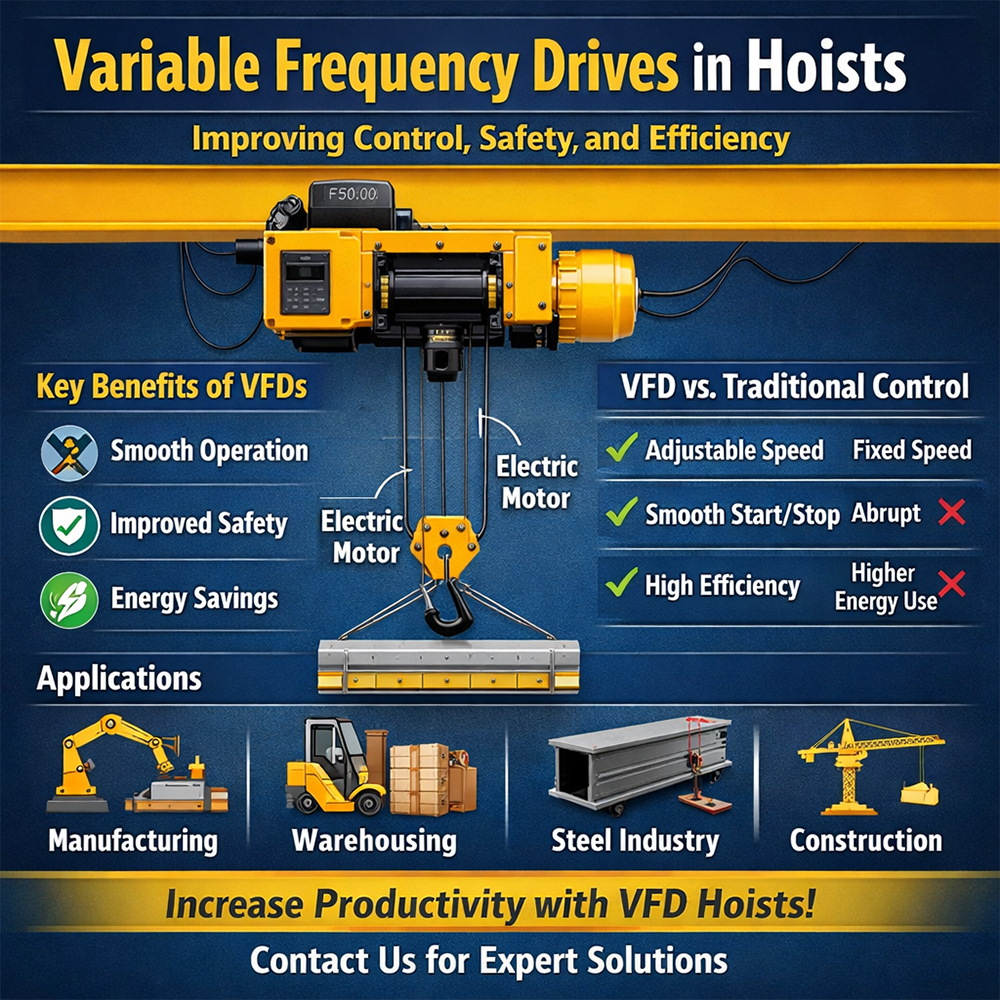
A Variable Frequency Drive (VFD) is an electronic device that controls the speed and torque of an electric motor by adjusting the frequency and voltage of the power supply.
Instead of running at a constant speed, a motor equipped with a VFD can accelerate, decelerate, and operate at different speeds depending on the lifting requirements.
Key functions include:
This flexibility makes VFDs ideal for lifting applications where control and safety are essential.
In a hoist system, the VFD is connected to the motor and regulates its operation in real time.
When the operator starts the hoist, the VFD gradually increases the motor speed rather than applying full power instantly. Similarly, during stopping, it reduces speed smoothly instead of abrupt braking.
This controlled movement ensures:
By managing acceleration and deceleration, VFDs significantly improve overall system performance.
One of the biggest advantages of VFD technology is smooth motion control. The hoist can start and stop gradually, eliminating jerks and reducing load swing.
This is especially important in applications requiring accurate positioning, such as assembly lines or precision lifting tasks.
Safety is a major concern in lifting operations. Sudden movements can cause load instability and accidents.
With VFD control:
This leads to a safer working environment.
VFDs optimize motor power usage based on actual load requirements. Instead of running at full speed all the time, the motor only consumes the energy needed for the task.
This results in:
Frequent sudden starts and stops can cause significant wear on motors, brakes, and gears.
VFDs reduce mechanical stress by:
This helps lower maintenance costs and improve system reliability.
With adjustable speed settings, operators can handle loads more precisely.
This is particularly useful for:
VFD-equipped hoists are widely used in industries that require high precision and efficiency.
Typical applications include:
In these environments, smooth operation and precise control are critical for productivity and safety.
Feature |
VFD Control |
Traditional Control |
Speed Control |
Adjustable |
Fixed |
Start/Stop |
Smooth |
Abrupt |
Energy Efficiency |
High |
Lower |
Load Stability |
Excellent |
Limited |
Equipment Wear |
Reduced |
Higher |
This comparison clearly shows why VFD technology is becoming the preferred choice in modern hoist systems.
When selecting a hoist with VFD, consider the following factors:
Quick tips:
1. What is the main purpose of a VFD in hoists?
To control motor speed and ensure smooth, efficient operation.
2. Does a VFD reduce energy consumption?
Yes, it adjusts power usage based on actual load, improving efficiency.
3. Is a VFD necessary for all hoists?
Not always, but it is highly recommended for precision and high-frequency applications.
4. Does VFD improve safety?
Yes, it reduces sudden movements and improves load stability.
Variable Frequency Drives have transformed modern hoisting systems by improving control, efficiency, and safety. Compared to traditional systems, VFD-equipped hoists offer smoother operation, lower energy consumption, and longer equipment life.
For businesses looking to enhance productivity and reduce long-term costs, investing in VFD technology is a smart choice.
Looking for a high-performance hoist with VFD control?
We can help you:
Contact us today for expert advice and quotation.
 Hot News
2026-09-21
2026-09-02
2026-08-19
2026-07-15
2026-07-09
2026-07-01
 EN
EN