 EN
EN


JIB Cranes:Precision Positioning for Accurate Point-to-Point Transfers
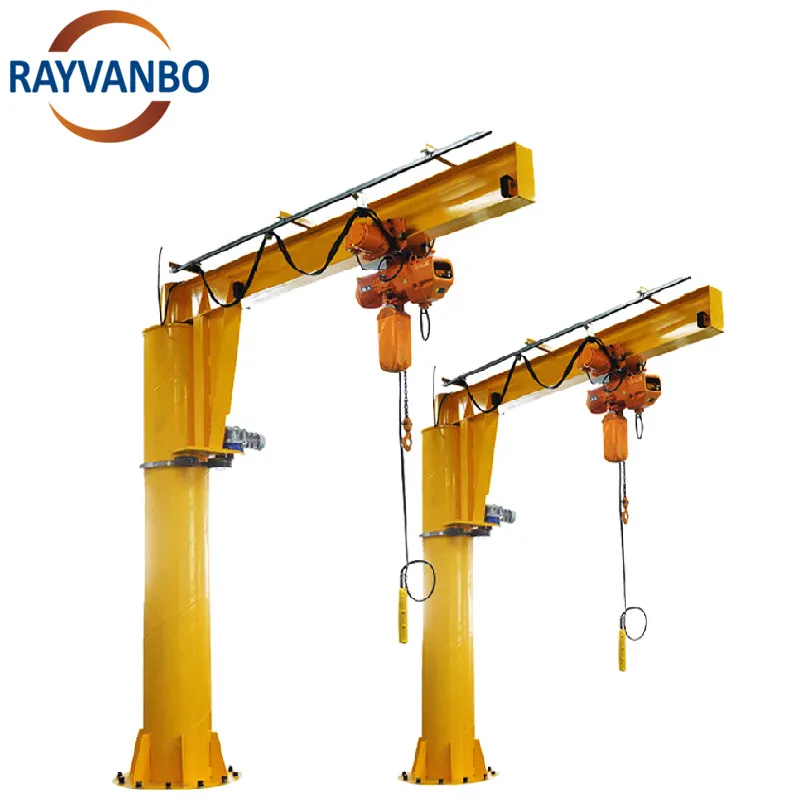
Sub-centimeter accuracy via slewing and trolley control
JIB Cranes achieve incredible precision down to about 5mm thanks to their synchronized slewing rotation combined with smooth trolley movement. What makes these cranes stand out is their ability to maintain millimeter accuracy even when handling different loads throughout the day. The crane can rotate anywhere from 270 to 360 degrees, which means operators don't have those annoying blind spots when moving parts between workstations. Speed control features let workers zip across large factory floors quickly, then slow down for those delicate final adjustments needed at specific locations. Built-in sensors automatically correct for any swinging or instability in the load, keeping everything right where it needs to be without constant manual adjustments. For companies making sensitive electronic components, this kind of precision actually cuts down on damaged parts by around 34%, according to recent studies from the Material Handling Institute in 2024. Factories report saving nearly half the time spent moving items from one spot to another compared with older hoisting systems, simply because they no longer need to stop and manually adjust positions so often.
Case study: 37% faster load placement in automotive subassembly
A major car manufacturer installed JIB Cranes to move engine blocks between machining areas and assembly lines, which made the process about 37% quicker compared to when workers did it manually or used forklifts. With these cranes in place, there was no need for intermediate staging areas anymore, cutting down on handling steps by around 60%. The precise positioning meant nobody had to spend extra time aligning things properly, something that used to eat up roughly 18 minutes every hour. When looking at cycle times, consistency improved dramatically from just 74% reliability with forklift operations to an impressive 98% with the new system. Plus, those built-in collision avoidance features saved the company approximately $120,000 per year in damaged parts. Looking at what happened after installation, employee fatigue levels dropped by 23%, and there were 31% fewer accidents worth reporting to OSHA. All this shows why integrating JIB Cranes makes sense for improving both how smoothly things run and keeping everyone safe on the shop floor.
Space-Efficient Operation in Constrained Manufacturing Environments
Radial reach vs. footprint: Why JIB Cranes outperform forklifts and overhead systems in tight zones
When floor space gets tight, workflow efficiency drops dramatically - studies show around 37% reduction in crowded facilities according to Ponemon Institute research last year, mostly because materials just don't flow properly through cramped areas. JIB Cranes tackle this problem head on with their compact design that offers impressive reach despite taking up minimal room. These cranes sit on a single column but still provide complete 360 degree movement, no need for those big turning spaces forklifts require or all that extra infrastructure overhead cranes demand. Installation is straightforward too since they attach right to current floors or building columns without expensive renovations, keeping valuable aisles open for other operations. The real advantage comes when working in small spaces under 5 square meters where most conventional lifting equipment simply won't fit. With these cranes, workers actually get about two thirds more usable space underneath the operating area, turning what were once dead ends into productive work centers where things can really move forward.
Reduced Manual Handling and Associated Operational Downtime
Eliminating human-lift dependency to cut fatigue-related errors and cycle delays
When workers handle materials manually, there are basically three big problems that pop up. First off, people get tired which leads to all sorts of alignment issues and dropped stuff. Second, the risk of back injuries and other musculoskeletal problems jumps by around 37% compared to automated systems according to those NIOSH guidelines on ergonomics. And third, cycle times just aren't consistent because humans perform differently every time they do something. That's where JIB Cranes come into play. These cranes take the heavy lifting away from workers altogether by using precision controlled hoists along with properly guided trolley systems. The result? Less physical strain on employees, more predictable transfer speeds between stations, and fewer positioning mistakes since everything follows the same repeatable path each time it moves.
Seamless Integration into Automated Manufacturing Workflows
PLC-synchronized hoist and trolley timing with CNC and assembly line cycles
Production systems reach maximum efficiency when material movement works hand in hand with automation. JIB Cranes make this possible by integrating directly with Programmable Logic Controllers (PLCs). These cranes synchronize their various motions - lifting the hoist, moving along the trolley track, rotating around its axis - all timed precisely with the cycles of computer numerical control machines and the rhythm of assembly lines. With constant data exchange between systems, parts show up exactly when needed, often within fractions of a second. This eliminates those frustrating moments when machines sit waiting for materials to be moved, which wastes valuable production time and drives up costs.
Take a look at what happens at a typical CNC milling station where things really start to click. The JIB Crane brings over the next billet right when the tools need changing, cutting down on wasted time by about 17% compared to when humans do the loading manually according to Industrial Automation Review from last year. Pretty impressive stuff actually. Then there's the PLC logic that lets machines adjust their paths on the fly when something unexpected happens like a production line coming to a halt. This prevents those annoying domino effect delays that spread through connected work areas. And don't forget about all those sensors working behind the scenes too. They constantly tweak where everything goes so positioning stays spot on throughout the whole process. What this means is smooth transitions from one station to another without needing anyone standing around watching or waiting.
FAQ Section
What is the primary advantage of JIB Cranes in manufacturing?
JIB Cranes provide exceptional precision, reducing manual handling errors, improving safety, and enhancing efficiency by eliminating unnecessary steps in material movement.
How do JIB Cranes impact employee safety?
By reducing manual lifting, JIB Cranes lower the risk of injuries and associated fatigue, contributing to fewer accidents and improved workplace safety.
Why are JIB Cranes preferred in tight spaces?
Unlike other lifting equipment, JIB Cranes take up minimal space while offering full 360-degree movement, making them ideal for cramped manufacturing environments.
Can JIB Cranes integrate with existing systems?
Yes, they can easily synchronize with programmable systems to enhance production efficiency without necessitating costly modifications.